
 Menu
Menu 





Over the past few years, there has been an overwhelming shift in the SEO industry toward automation, scale, and more recently, AI-driven execution. It is undebatable that AI has introduced powerful efficiencies into workflows, however there is a growing misconception that it can replace the core principals and fundamentals that have driven long-term SEO success for decades. The reality is that when AI is overused—particularly in content creation and link acquisition—it does not enhance performance, it undermines it.
While Google’s official policy is that AI generated content is approved for use as long as it provides value and is of high quality, our real world experience has been significantly different. We have seen first hand similar content of similar quality — with one piece being AI generated and one piece being human generated — have significantly different ranking outcomes, with search rankings favoring the human generated content. Our real world R&D and experiments often contradict official search engine policies and news releases and unsurprising when it comes to AI that continues to be the case.
From 10 Million Impressions To 1,000 In Less Than A Year
This past month, we recently brought on a new client who serves as a perfect example of what not to do with AI when it comes to SEO strategy. This was not a new website, nor was it a struggling business trying to gain traction, this was a company that had spent years investing in high-quality SEO, building authority across dozens of markets, and generating consistent six-figure monthly revenue through organic search.
Their rankings were stable and their traffic was strong. Their upward growth trajectory was exactly what you would expect from a properly executed long-term SEO strategy with time-tested principals implemented by humans.
As is often the case, the desire to grow larger and faster took over, and their strategy shifted away from one of quality to one of mass production leveraging AI. In an effort to accelerate growth and scale more aggressively, the decision was made to lean heavily into AI-driven content generation and automated link building. On paper, the logic made sense—produce more content, acquire more links, and expand faster into additional markets, all while within the guidelines outlined by Google that AI content will rank the same as human generated content.
The content that was being produced at scale began to slowly result in less growth and less rankings. While it may have appeared optimized on the surface, it lacked the nuance, expertise, and intent alignment that had originally driven the site’s success through human generated content. At the same time, the link acquisition strategy transitioned toward volume-based tactics that introduced a significant number of low-quality and irrelevant backlinks into the site’s profile.
This shift did not immediately result in a collapse, which is often what makes these decisions so deceptive. For a period of time, performance appeared relatively stable. However, with two subsequent Google algorithm updates, the impact became undeniable.
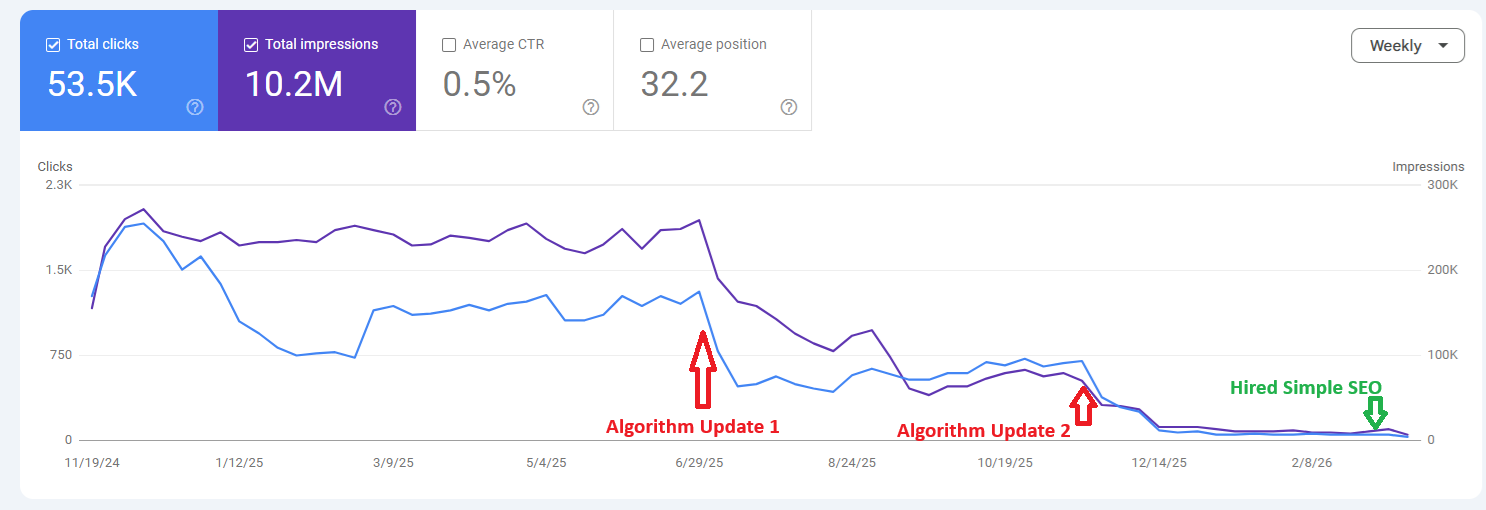
The first update led to a dramatic drop in traffic and impressions causing lead flow to decrease, and as a direct result, revenue followed. What had taken years to build was effectively dismantled in a matter of months. The financial impact alone was substantial, but more importantly, the underlying authority and trust that the site had established with search engines had been severely compromised. The second drop was the final nail in the coffin as traffic went from the business generating revenue to virtually zero organic traffic or organic revenue.
When the client came to us, the situation required far more than incremental adjustments. This was not a matter of optimizing a few pages or refining keyword targeting — the website and SEO strategy foundation itself needed to be completely rebuilt.
Our Approach To Restoring Rankings & Revenue
The first step was a comprehensive content audit — a significant portion of the AI-generated content had to be removed or completely rewritten. We focused on re-establishing content that was created with real intent, depth, and value—content that was clearly designed for users rather than algorithms and written by humans for humans.
Simultaneously, we conducted an extensive backlink audit. This process included identifying toxic, low-quality links that had been built during the previous AI strategy. Whenever possible, our team undertook the time consuming process of manually removing these links, and in cases where removal was not feasible, they were disavowed. From there, we began the process of rebuilding a clean and authoritative link profile aligned with best practices. Over the course of this drop, the client’s website domain authority also significantly dropped as further evidence that more links isn’t always better.
It is important to understand that once trust is lost, it is not instantly regained. Search engines require consistent signals over time to re-evaluate a site’s credibility.
Based on the current trajectory, we expect that over the next three to six months, the site will continue to regain authority, re-establish its rankings across key markets, and ultimately return to generating six-figure monthly revenue through organic search.
Key Takeaways In The AI SEO Era
We’ve been in the SEO business for nearly 20 years and this is not the first major shift we’ve seen. Years ago, private blog networks, content spinning machines and automated link building software were all the rage in the black hat SEO world, but were strategies we avoided due to the long term harm they would cause. The AI revolution is no different.
The takeaway here is not that AI should be avoided, actually quite the contrary — AI can be an incredibly effective tool when used appropriately. The issue arises when it replaces strategy rather than supports it and tries to automate human workflows at scale which require the nuanced approach of a human to get just right.
SEO has always been, and continues to be, rooted in quality, relevance, and trust. No level of automation can compensate for the absence of these fundamentals.
As we look ahead, the businesses that will succeed are not the ones that attempt to automate every aspect of their SEO strategy, but rather those that understand how to integrate AI in a way that enhances efficiency without compromising quality. As this case clearly demonstrates, when AI is overused, it does not create benefit—it creates risk and downside. And in many cases, that risk can erase years of progress almost overnight.
If you’d like to learn more about how we’re leveraging AI to produce quality SEO outcomes, schedule a consultation with our team and we’d be glad to help craft a time tested SEO and GEO strategy for your business to remain competitive in the AI era without compromising results.